

Updated January 2026: We have updated the article with the latest developments in AI-powered predictive health monitoring, IoT-integrated mobility aids, privacy-preserving edge AI, personalized care plans, hybrid tech-human support models, and emerging accessibility innovations such as voice-activated interfaces and robotic companions.
Optimizing E-E-A-T in Elderly Care through Assistive Technology
Abstract
Assistive technology is a rapidly evolving field that holds immense potential for enhancing the independence of individuals needing daily support, particularly seniors and individuals with disabilities. The ongoing developments in assistive devices are crucial given the shifting demographics towards an aging population. According to IMARC Group, the market for elderly and disabled assistive devices is expected to grow significantly from $32.9 billion in 2024 to $53.5 billion by 2033. This growth underscores the importance of technology in promoting independent living as part of a comprehensive care strategy.
Detailed Analysis of Assistive Technology for Independent Living
Assistive technology (AT) includes a variety of devices and systems designed to augment autonomy and safety for elderly and disabled populations. These devices range from mobility aids and communication tools to sophisticated smart home systems and specialized ergonomic furniture. The transition from simple devices to complex, integrated systems illustrates the profound impact of assistive technology on daily life for those with specific needs. Recent advancements now include AI-powered smart mobility aids, incorporating obstacle detection, adaptive speed control, and real-time health monitoring. These technologies often connect with mobile apps, allowing for remote customization, Bluetooth connectivity, and even voice control, which collectively enhance user independence and safety.[1][2]
In 2025 and beyond, assistive technology reflects a shift toward AI-driven smart devices such as smart glasses (e.g., OrCam MyEye 3.0, Envision Glasses), which provide real-time object recognition, facial expression detection, and indoor navigation, increasing autonomy especially for visually impaired users. The integration of AI, IoT, and wearable technology enables smart prosthetics, AI-enhanced hearing aids, and adaptive mobility devices that adjust dynamically to user movements and the surrounding environment, further improving independence.[1][2][8]
Current innovations include AI-powered predictive health monitoring, where advanced systems support proactive care. For example, embedded devices such as smart toilet seats can analyze health indicators, while longevity stations combine continuous body scans with predictive analytics. Fall detection systems have also evolved, now adapting to an individual’s gait patterns for greater accuracy.[4]
IoT-integrated mobility aids such as wheelchairs, walkers, and scooters now come equipped with sensors to monitor usage patterns, battery status, and detect unusual movements or falls, with data automatically shared with caregivers and healthcare providers. Powered mobility devices can respond to voice commands for fine positioning adjustments, supporting convenience and independence.[2]
Edge AI technology is increasingly adopted for privacy-preserving safety: ambient intelligence processes data locally on devices instead of in the cloud, enabling automatic safety responses such as shutting off appliances when a resident leaves the area, while maintaining user dignity and privacy.[4]
A further notable trend is the emergence of integrated AI assistants, which function beyond standalone apps to offer seamless, interactive guidance. These AI-powered assistants help users quickly access information, navigate environments, and interact with technology in real time.[9]
Assistive technology now supports highly personalized care plans, facilitating individualized wellness approaches including tailored fitness routines, nutrition, and daily programming according to user preferences and real-time feedback. This supports a resident-driven, whole-person care model.[8]
Hybrid tech-human models remain fundamental: while technology offers crucial support and wellbeing tracking, it is widely recognized that these solutions should enhance—not replace—human connection and care.[8]
In practice, consider “Mr. Thompson,” an 80-year-old with limited mobility, who effectively manages household chores using a smart home network that automates lighting, temperature, and security. This is one of many real-world scenarios where assistive devices change lives, with Market.us Media reporting that 39% of individuals with severe disabilities use such technology, highlighting its critical role in fostering independence. Voice-activated home automation systems and hands-free home controls have become widely accessible and integrated, lowering practical barriers by enabling control of lighting, climate, and security systems without physical effort.[3][4]
Additionally, new accessibility innovations are emerging, such as voice-activated interfaces for hands-free environmental controls, nanotechnology for self-repairing materials and skin health monitoring, robotic companions for alleviating loneliness and cognitive decline, smart home integration for reduced physical effort, and wearable devices monitoring vitals, activity, and risk factors.[1][2][4]
Additionally, innovative cross-overs with consumer electronics have broadened the scope of assistive devices, from customizable gaming controllers to sensory wearables and motorized makeup applicators.[10]
Customized Solutions to Meet Individual Needs
Choosing the right assistive technology is an intricate process that requires personalized evaluation. Health professionals play a significant role in these assessments, connecting specific disabilities with suitable technologies. Consider “Ms. Garcia,” whose healthcare provider collaborated with her to select a mobility aid that significantly enhanced her capacity to engage in daily activities confidently. Insights from The Business Research Company stress the importance of customizing technology solutions to maximize benefits and improve user experience. Contemporary practice increasingly adopts a person-centered, holistic approach, integrating physical and mental health considerations as well as user preferences and feedback. Rehabilitation and support are now designed to reflect a whole-person philosophy, particularly supporting individuals with intellectual and developmental disabilities.[7][11]
Advances in design are also emphasizing ergonomic and inclusive solutions rooted in neurodiverse and age-focused principles. This includes interfaces with simplified navigation, larger fonts, and cognitive ease to address the needs of seniors and users with sensory or cognitive impairments. Universal standards for accessibility are being developed and implemented to ensure assistive devices benefit a broader audience.[12]
Financial Accessibility and Support Mechanisms
Financial considerations are often a barrier to adopting advanced assistive technologies. Exploring insurance coverage and government initiatives is vital to bridging this gap. For instance, a cost-benefit analysis depicted by Desklib Research illustrates how initial investments in assistive devices can result in long-term savings by reducing reliance on extensive personal care. Awareness of grants and financial assistance programs can enable seniors, like “Mrs. Johnson,” to acquire innovations like smart wheelchairs, enhancing their independence affordably. Recent policy changes and expanded funding programs are increasing accessibility to the latest AI-enabled and connected assistive technologies, helping to ensure equitable access.[1]
Regulatory updates in 2025 have introduced stricter and more user-focused accessibility standards, such as those under the forthcoming WCAG 3.0 guidelines, supporting the widespread adoption of inclusive technology.[12]
Emerging Technologies and Trends: Looking Forward to 2025
Emerging trends in assistive technology promise substantial advancements, particularly with AI and machine learning driving smart home integration and telehealth services. For seniors, AI-enabled devices—like sophisticated fall detection systems—provide safety while promoting autonomy. According to Precedence Research, these trends are shaping a future where assistive technology not only supports but transforms living environments into spaces of empowerment and dignity. New directions also include widespread adoption of wearable health monitoring devices, smart building automation, and telemedicine for proactive, remote healthcare support.[5][6]
Recent innovations have combined assistive technologies with mainstream consumer electronics, expanding their utility in everyday life. For example, customizable and accessible gaming controllers or adaptive interfaces enable participation in digital entertainment, while AI-powered sensory wearables increase engagement and independence.[10]
Sustainability and the use of energy-efficient solutions in product and interior design are gaining importance, reflecting environmental responsibility alongside user-centered innovation.[6]
Supporting Aging in Place: A Practical Option
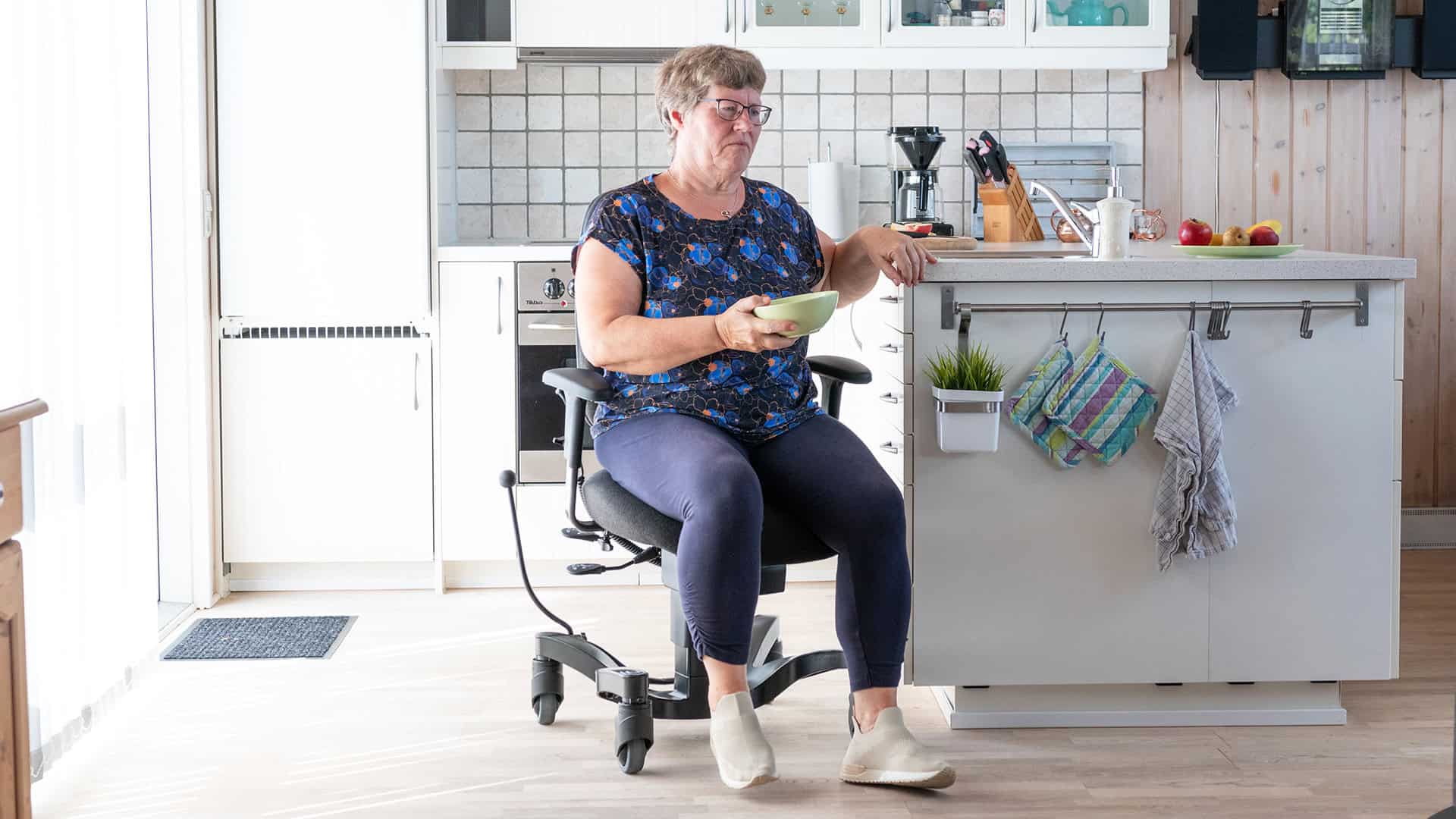
Mobility solutions such as VELA Chairs play a pivotal role in helping individuals stay independent longer in their own homes. Features like the central brake provide exceptional safety, while electric height adjustability ensures ease of transfers and reduces the risk of falls. With its ability to facilitate movement while seated, the VELA Chair conserves energy, allowing seniors to engage in activities such as cooking or cleaning without undue fatigue. Life with a VELA Chair offers greater dignity and freedom, postponing the need for a nursing home by enhancing everyday life significantly. Although not the only available solution, the VELA Chair stands as a proven, practical choice for those seeking to maintain autonomy and comfort at home. Explore additional Mobility Chairs for Independence to discover other assistive solutions tailored for daily living. Additionally, for those interested in ergonomic benefits, consider Sit-to-Stand Lift Chairs as an option to enhance posture and safety while navigating daily routines.
- Assistive Tech Hub, “Top Assistive Tech Innovations in 2025 You Need to Know,” June 6 2025
- Everything Medical Online, “The Latest Trends in Mobility Aid Technology for 2025,” May 30 2025
- ButterflyMX, “Senior Living Technology Trends 2025: Shaping the Future of Care,” July 11 2025
- Heisinger Bluffs, “The Future of Senior Living: Trends to Watch in 2025,” January 13 2025
- Juniper Communities, “Senior Living Trends in 2025,” July 25 2025
- LCSnet, “2025 Trends in Senior Living Shaping the Future of Communities,” March 12 2025
- Dr. Craig Escudé, “Seven Trends to Look For in 2025 in Supporting Individuals With Intellectual and Developmental Disabilities (IDD),” December 19 2024
- Cognitive Market Research, “Assistive Technology Market Report 2025,” June 2025
- LetsEnvision Blog, “Future of Assistive Tech: Integrated AI Assistants,” August 2025
- Accessibility.com, “Innovations in Assistive Tech,” May 2025
- StartUs Insights, “Longevity Technology Trends: Top 9 in 2025,” April 2025
- Continual Engine, “15 Digital Accessibility Trends to Watch in 2025,” January 2025
- Heisinger Bluffs, “The Future of Senior Living: Trends to Watch in 2026,” January 2026